

Abstract
Why do individuals with unusually high cognitive abilities sometimes encounter distrust, marginalization, ridicule, or active social resistance instead of recognition proportional to their capabilities? Social psychology offers several established mechanisms, including social comparison, envy, status threat, hierarchical competition, and the Tall Poppy phenomenon. These mechanisms describe important aspects of the immediate social dynamics, but they may not exhaust the adaptive problem.
This essay introduces the Adaptive Cognitive Tail Hypothesis (ACT), a candidate domain hypothesis inspired by the Meta-Evolution research program. Meta-Evolution treats intelligence within the broader evolution of adaptive information processing and proposes Adaptive Diversity as a potentially important resource for robustness under changing or unpredictable environmental conditions. The framework explicitly keeps such generalizations empirically open rather than treating them as established universal laws (Hoffman, 2026).
Two concepts must be distinguished. Cognitive Tail (CT) refers only to a pre-specified upper region of the empirical distribution of a particular cognitive ability. It assumes neither a normal distribution nor any special adaptive function. Adaptive Cognitive Tail Hypothesis is a separate empirical proposition: some abilities represented in such a tail may have limited relative value under typical conditions but acquire greater relative value when the class of problems facing the system changes.
ACT does not claim that evolution intentionally produces geniuses as reserves for future crises, that high intelligence entails creativity or rationality, that cognitively exceptional individuals are necessarily correct, or that greater intelligence always increases fitness. Rather, it proposes that the value of rare cognitive capacities may depend on the interaction among the ability being considered, environmental novelty, the structure of the problem, social organization, and the capacity of a group to understand, test, transmit, and use unusual solutions.
The social consequence follows conditionally. A rare cognitive capacity may be difficult to integrate under ordinary conditions and useful under novel ones. If organizations suppress cognitive variation that is currently inconvenient but potentially useful under future conditions, mechanisms that improve short-term coordination may sometimes reduce long-term adaptive flexibility.
Keywords: cognitive diversity; intelligence; extreme cognitive ability; adaptation; Tall Poppy; team cognition; Meta-Evolution; organizational integration
Contents
1. Intelligence in an Adaptive Perspective
2. Evolution Does Not Maximize Intelligence
3. Cognitive Tail: A Distributional Description
4. The Adaptive Cognitive Tail Hypothesis
5. Cognitive Distance and Integrative Capacity
6. Rationality, Social Intelligence, and the Limits of High IQ
7. Tall Poppies, Status, and Hierarchy
8. Environmental Change and the Latent Value of the Tail
9. Illustrative Applications
10. Predictions and Falsification
11. Relation to Meta-Evolution
12. Conclusion
13. References
1. Intelligence in an Adaptive Perspective
Intelligence is usually described as a property of an individual: the ability to learn, solve problems, form representations, reason about relationships, anticipate outcomes, or reorganize behavior in response to new information.
An evolutionary perspective raises a more fundamental question: Why should a particular cognitive ability be useful in a particular environment?
Meta-Evolution places cognition within a longer organizational history of adaptive information processing. Its conceptual account describes a progression from relatively fixed responses toward learning, memory, prediction, planning, abstraction, and reflection. Higher cognitive organization expands the range of adaptive information that can be generated during the lifetime of an organism rather than inherited exclusively through slower evolutionary processes (Hoffman, 2026).
This perspective does not imply that all cognitive functions constitute a single psychological variable. General cognitive ability, fluid reasoning, working memory, learning speed, creativity, cognitive flexibility, social cognition, and emotional processing are related but non-identical constructs. A person located in the extreme upper range of one ability need not occupy the same position in another.
This distinction is essential for ACT. The hypothesis should not be interpreted as describing an unspecified psychological type called a “genius.” The term is retained in the subtitle because it captures the social phenomenon under discussion, but it is not an operational scientific category.
More precisely, ACT should be treated as a family of domain hypotheses indexed by a previously specified cognitive ability or cognitive profile. A study might therefore concern the upper tail of general cognitive ability, fluid reasoning, working-memory capacity, or some other independently defined ability. If an observed adaptive effect turns out to be caused by expertise, creativity, social intelligence, or another variable rather than the ability used to define the tail, then the corresponding ACT hypothesis has not been confirmed.
The adaptive value of cognition is therefore relational. It depends on the interaction between the cognitive architecture of an individual and the structure of the problems generated by the environment.
2. Evolution Does Not Maximize Intelligence
Evolution does not maximize individual traits independently of their costs. Every trait exists within a network of energetic, developmental, reproductive, ecological, and behavioral trade-offs. Neural tissue is metabolically expensive, and additional cognitive capacity does not automatically produce a proportional adaptive benefit (Fonseca-Azevedo & Herculano-Houzel, 2012).
Empirical work illustrates this context dependence. Research on wild primates has shown that performance on particular cognitive tasks can be associated with survival (Fichtel et al., 2023). Conversely, studies of free-foraging bumblebees have found that faster learning does not necessarily translate into greater lifetime resource acquisition (Evans et al., 2017). Cognitive superiority on one measure is therefore not equivalent to greater fitness in every ecological context.
The simple rule ‘more cognition = more fitness’ is untenable.
A stronger claim sometimes follows intuitively: individuals should never be ‘more intelligent than the environment requires.’ That formulation is also too strong. Natural selection does not tune every member of a population to one sharply defined optimum. Populations retain genetic and developmental variation, inherit historical constraints, undergo recombination and drift, and experience multiple simultaneous selective pressures. Traits may also be correlated with other traits, producing phenotypic values that are not directly optimized in isolation.
A more defensible proposition is narrower: persistent selection for an increase in a cognitive ability should not be expected when the additional costs of that ability are not compensated by adaptive benefits across a sufficiently important range of environmental conditions.
This does not imply that variation beyond the range most useful under ordinary conditions has no adaptive significance. Its significance may be conditional. A phenotype weakly useful under frequently encountered conditions can become valuable under rare conditions. That possibility is the evolutionary opening for ACT.
3. Cognitive Tail: A Distributional Description
The concept of genius often suggests a qualitative boundary between ordinary and extraordinary minds. A distributional interpretation is more conservative.
Genetic research on extremely high intelligence has supported the view that extreme general cognitive ability is quantitatively continuous with variation found across the wider population rather than forming a separate genetic category (Zabaneh et al., 2018).
This allows the analysis to begin without invoking ‘genius’ as a biological type.
Cognitive Tail (CT)
A pre-specified upper region of the empirical distribution of a particular cognitive ability. CT does not assume a normal distribution and does not imply adaptive value, creativity, rationality, social status, or epistemic correctness.
The definition is deliberately minimal. A tail may be defined by a percentile, quantile, threshold derived from an independently validated instrument, or another criterion appropriate to the domain.
The decisive methodological condition is that membership in CT must be specified before observing the adaptive outcome that ACT is intended to explain. Otherwise, the hypothesis becomes circular.
CT itself says nothing about whether its members are more adaptive, more creative, more rational, possess greater expertise, produce better ideas, are socially difficult, are more frequently marginalized, or become more useful during crises. Those are separate empirical questions.
This distinction is central: Cognitive Tail is descriptive. Adaptive Cognitive Tail is functional and hypothetical. The adaptive conclusion must therefore be earned by observation rather than inserted into the definition.
4. The Adaptive Cognitive Tail Hypothesis
The Adaptive Cognitive Tail Hypothesis proposes that, in some domains, the relative value of abilities represented in the upper tail of a cognitive distribution changes with the structure of the problems confronting the system.
Under stable conditions, much adaptive behavior can rely on previously successful solutions. Institutions preserve procedures. Culture preserves knowledge. Organizations encode routines. Professional specialization reduces the need for every individual to rediscover solutions independently. Such systems can be highly efficient.
Under these circumstances, the marginal benefit of a rare cognitive capacity may be small. A person capable of solving a class of problems that rarely occurs may contribute little through that particular ability during normal operation.
This changes when the problem distribution changes. Previously reliable procedures may fail. Established predictive models may lose accuracy. A new technology, environmental shock, institutional crisis, scientific anomaly, or adversarial condition may generate problems for which the existing repertoire of responses is insufficient.
ACT predicts that some abilities previously concentrated in the upper cognitive tail may then acquire greater relative value.
The claim is explicitly conditional. Not every cognitive tail should show this effect. Not every environmental change should reward the same ability. Not every individual in CT should produce a useful response. And not every unusual solution should be correct.
The hypothesis concerns an interaction between a specified capacity and a specified problem regime. For the same reason, ‘adaptive value’ cannot be assigned one universal measure.
In a laboratory task it might mean solution accuracy, recovery after a rule change, or time required to discover a new strategy. In an organization it might mean maintenance of function after a disruption, successful generation of a replacement strategy, or recovery speed. In an ecological domain it might involve survival, resource acquisition, reproduction, or another independently justified fitness-related outcome.
The adaptive outcome must therefore be defined locally, before testing ACT.
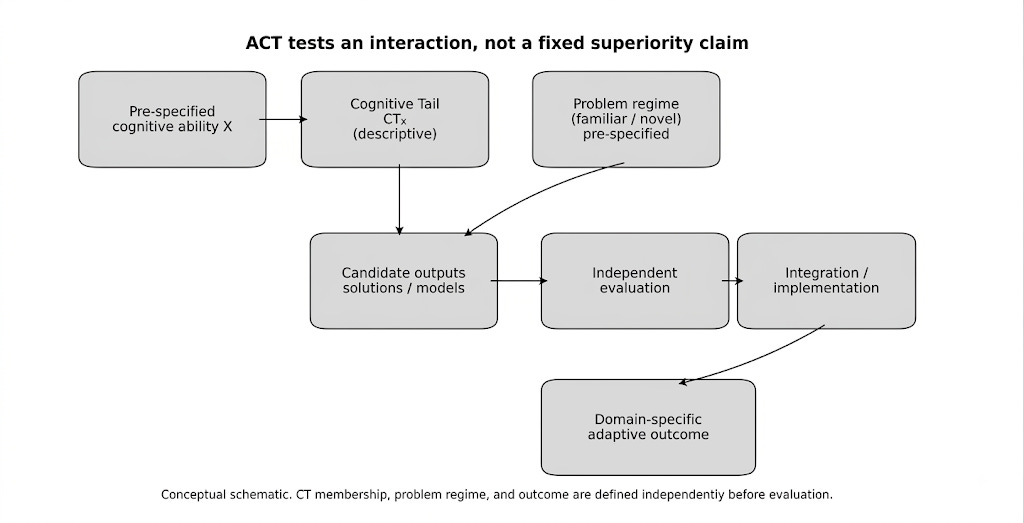
Figure 1. Core ACT architecture. Cognitive Tail, problem regime, and adaptive outcome are specified independently before the hypothesis is evaluated. The diagram is conceptual, not a formal model.
5. Cognitive Distance and Integrative Capacity
A rare cognitive ability has little collective value if the information generated through it cannot be incorporated into group behavior. ACT therefore distinguishes two questions: Can an individual generate useful information? And can the surrounding system recognize and integrate it? These are not the same problem.
It would be too strong to assume that membership in CT automatically creates representational distance. A highly capable individual may communicate extremely well. The surrounding group may also possess sufficient expertise to reconstruct the same reasoning.
Representational distance should instead be treated as a relational phenomenon involving the individual, the problem, and the cognitive resources available to the surrounding group. A mismatch can emerge when one person represents a problem using distinctions, abstractions, causal structures, or compressed reasoning that others cannot readily reconstruct.
The resulting social interpretation may then diverge from the epistemic content. Compressed reasoning can be interpreted as arrogance. High abstraction can be interpreted as impracticality. Persistent criticism of hidden assumptions can be interpreted as contrarianism. A warning about a problem not yet visible to the group can be interpreted as needless pessimism.
These reactions are possible outcomes, not necessary consequences of high ability.
Integrative capacity
The independently observable ability of a group to understand a proposal sufficiently to reconstruct it, test its consequences independently of its author, transmit it to other members, incorporate it into action when warranted, and reject it when evidence shows it to be wrong.
Research on team cognition and shared mental models provides an important empirical background for this distinction. Effective teamwork does not require identical mental representations among all members. What matters is whether knowledge relevant to coordinated action is sufficiently organized, distributed, and shared to support collective performance (Mathieu et al., 2000; DeChurch & Mesmer-Magnus, 2010).
Burke and colleagues similarly describe team adaptation as a dynamic process involving recognition of changed conditions, plan formation, execution, and learning (Burke et al., 2006). This is closely aligned with the ACT requirement that unusual information must pass through an organizational integration process before it can affect adaptive outcomes.
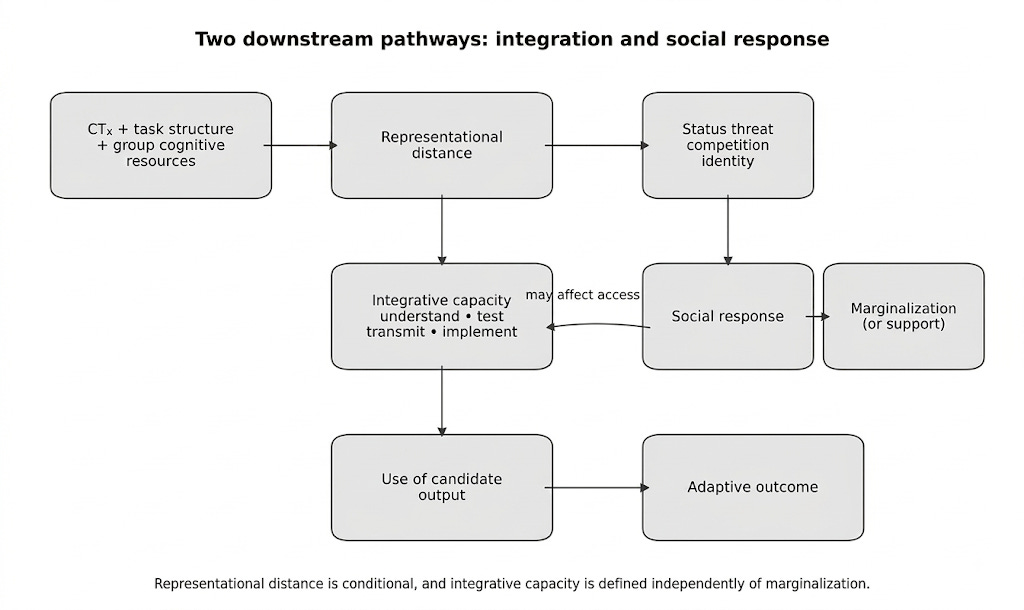
Figure 2. Social and integrative pathways are distinct. Representational distance is conditional, status processes can affect social response, and integrative capacity is defined independently of marginalization.
6. Rationality, Social Intelligence, and the Limits of High IQ
ACT requires another firewall: high cognitive ability is not equivalent to rationality.
The heuristics-and-biases tradition initiated by Tversky and Kahneman demonstrated systematic deviations in human judgment under uncertainty (Tversky & Kahneman, 1974). Kahneman later synthesized a broader literature on fast, intuitive processing and slower forms of deliberation (Kahneman, 2011).
These results should not be interpreted as showing that intelligence is irrelevant. They show something more precise: cognitive performance cannot be reduced to a single scalar measure, and sophisticated reasoning capacity does not abolish every source of judgment error.
Stanovich develops this distinction more directly. His work separates abilities commonly captured by intelligence tests from dimensions of rational thought and decision making that such tests do not fully measure (Stanovich, 2009).
This has a direct consequence for ACT: CT membership cannot be treated as evidence that a person’s beliefs are correct. An individual may possess exceptional fluid reasoning and still use poor premises. A brilliant abstract thinker may exhibit motivated reasoning. A technically powerful solution may optimize the wrong objective. An outlier may simply be wrong. ACT therefore requires independent evaluation of outputs.
A second distinction concerns social and emotional abilities. Goleman’s Emotional Intelligence played an influential role in popularizing the idea that cognitive ability alone does not determine effective interpersonal functioning (Goleman, 1995). For a more explicit research framework, Mayer, Salovey, and Caruso treat emotional intelligence as a distinct theoretical construct involving abilities related to perceiving, understanding, and managing emotion (Mayer et al., 2004).
This matters because some conflicts attributed casually to ‘genius’ may actually reflect combinations of different traits. High analytical ability accompanied by strong communication and social cognition may be readily integrated. The same analytical ability combined with poor perspective taking or weak communication may generate substantial interpersonal friction.
ACT should therefore not explain every social difficulty of cognitively exceptional individuals through representational distance or status threat. Social competence is an independent variable.
7. Tall Poppies, Status, and Hierarchy
Representational mismatch is only one possible mechanism of social resistance. Another concerns status.
Classical Tall Poppy research focuses primarily on reactions to conspicuously successful or high-achieving individuals, not on high IQ itself (Feather, 1989). This distinction must remain explicit.
Yet research in organizational psychology provides more direct evidence that high performance and cognitive ability can become socially costly under particular conditions. Kim and Glomb found an association between cognitive ability and workplace victimization, moderated by interpersonal characteristics (Kim & Glomb, 2010). Their later research on high performers identified envy as one mechanism linking high performance to victimization, while stronger identification with the work group reduced the effect (Kim & Glomb, 2014).
Reh, Tröster, and Van Quaquebeke examined a related mechanism involving anticipated future status threat. A rapidly improving coworker can become threatening before overtaking anyone formally, because others anticipate future changes in relative position (Reh et al., 2018).
These findings do not establish that people generally dislike intelligent individuals. A more defensible interpretation is conditional: exceptional ability can increase the probability of negative social responses when it becomes coupled to status competition, perceived future displacement, weak group identification, difficulty evaluating the person’s contribution, or other socially threatening conditions.
ACT adds an organizational question. What happens when competence relevant to a newly important problem is located outside the formal center of decision authority? The organization may contain one hierarchy of control and another distribution of problem-specific competence. When the two diverge, a local organizational conflict becomes possible.
The system can respond by transferring information into the decision process. Or it can defend the existing hierarchy against the source of the discrepancy.
This should not be called Adaptive Locus Migration automatically. Meta-Evolution explicitly distinguishes information carrier, adaptive functions, control, and Adaptive Locus, and requires a broader documented change in the combined functional profile before Adaptive Locus Migration can be inferred (Hoffman, 2026). ACT therefore treats competence-control mismatch only as a local domain mechanism.
8. Environmental Change and the Latent Value of the Tail
The central prediction of ACT concerns changing conditions.
Evidence from several domains supports the broader proposition that the value of cognitive organization can depend on environmental structure. Comparative work in birds has found an association between environmental variability and relative brain size, a result compatible with the cognitive-buffer hypothesis (Sayol et al., 2016). This does not establish causation and operates at the interspecific level rather than the individual level, so it should not be treated as direct evidence for ACT.
Baggio and colleagues provide a different type of evidence. In groups managing a common resource, combinations of general and social intelligence were associated with better collective performance under deteriorating environmental conditions (Baggio et al., 2019). Again, this is not evidence for an upper-tail effect. It concerns functional cognitive diversity rather than the extreme upper end of one cognitive distribution.
Its relevance is narrower but important: the adaptive value of cognitive composition can depend on the conditions under which a group operates.
ACT makes a more specific prediction. After CT has been defined independently for a particular ability, its relative contribution should be compared across different problem regimes.
A useful result would not merely show that high-capacity individuals perform better in general. It would show that the relative contribution associated with CT changes when the system moves from familiar or routine problems toward problems that are novel, poorly modeled, rapidly changing, or structurally different from those for which existing responses were developed.
This effect may also be delayed. Environmental change does not directly produce adaptive success. A system may first need to recognize that its previous model has failed. An alternative must then be generated, evaluated, communicated, and incorporated into action.
ACT therefore allows a time interval between environmental perturbation and the realization of value from a rare cognitive capacity. The relevant timescale is domain-specific. It might be minutes in a laboratory task, weeks or months in an organization, and much longer in cultural or institutional adaptation.
Failure to observe an immediate benefit after perturbation is therefore not sufficient to reject ACT if the study design specifies a justified integration interval in advance.
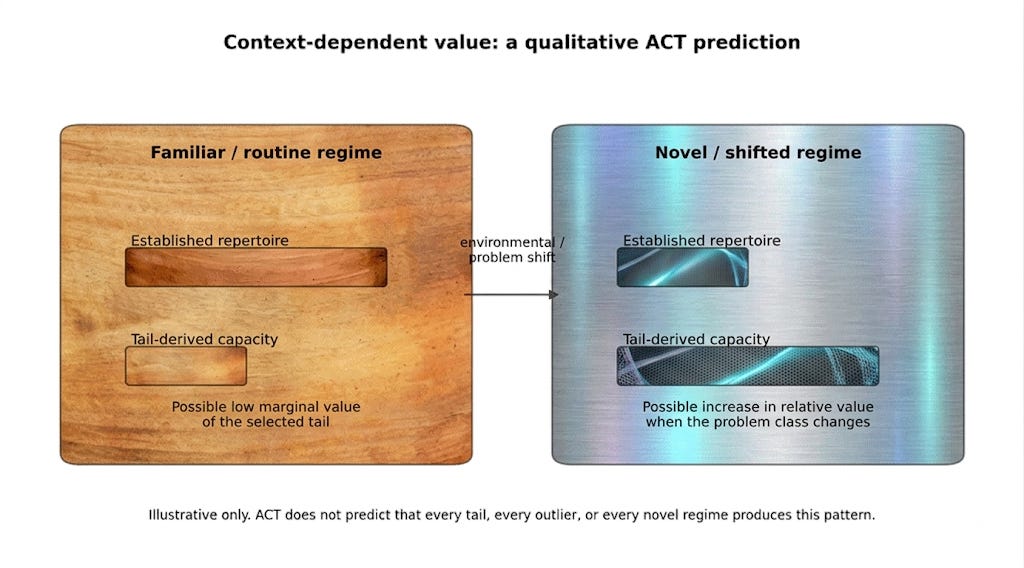
Figure 3. Qualitative illustration of the core ACT prediction. Relative value can change across problem regimes; the figure does not imply a universal monotonic relationship or a quantitative effect size.
9. Illustrative Applications
The following examples are applications of the hypothesis, not evidence for ACT. Their purpose is to clarify what the hypothesis would ask in different environments without retrospectively labeling successful individuals as members of an adaptive tail.
9.1 A research group facing an anomaly
Consider a research program whose prevailing model explains almost all observations but repeatedly fails in one narrow regime. One researcher proposes a representation substantially different from the shared framework used by the rest of the group.
ACT does not ask whether this researcher is a genius. It asks whether a pre-specified rare cognitive capacity is relevant to generating the alternative, whether the value of that capacity increases once the anomaly becomes scientifically important, and whether the group possesses sufficient integrative capacity to evaluate the new proposal independently.
If the proposal fails, CT membership provides no protection. If it succeeds, the relevant observation is not social vindication but the interaction between cognitive variation and a changed problem regime.
9.2 An organization after an unexpected disruption
Consider an organization optimized for stable operating conditions. Its procedures are efficient precisely because most decisions have already been standardized. A sudden disruption makes some of those procedures ineffective.
An employee whose cognitive profile was previously poorly utilized generates a viable alternative strategy. ACT predicts neither that such an employee must exist nor that the proposal must succeed. It asks whether particular rare capacities become more useful when the environment leaves the region for which routine procedures were optimized.
This case also exposes the role of integrative capacity. An organization able to test and implement the proposal can capture its potential value. An organization that evaluates ideas primarily through hierarchy may fail to do so.
9.3 Competence outside the formal hierarchy
Consider a team in which a low-status member possesses knowledge or cognitive capability that suddenly becomes central to a new problem.
This configuration allows several mechanisms to be separated. Problem-specific ability can be measured independently. Status is known. The quality of proposed solutions can be evaluated independently. Integrative capacity can be observed through the team’s ability to test and use those solutions.
Social resistance can then be examined without assuming in advance that rejection proves the lower-status member correct. This is particularly important for ACT because it prevents a common retrospective error: treating later success as evidence that earlier opposition must have been irrational.
10. Predictions and Falsification
ACT is scientifically useful only if it can fail.
Its first prediction concerns ability by problem-regime interaction. After defining CT for a particular cognitive ability, the relative contribution of that tail should be tested across familiar and novel problem regimes. ACT predicts that some tails will show increased relative value when the relevant class of problems changes.
The distinction between familiar and novel problem regimes must likewise be specified independently of CT performance and before the adaptive outcome used to test ACT is evaluated. This protects the hypothesis against retrospective relabeling of tasks as ‘novel’ only when CT performs well.
Its second prediction concerns integrative capacity. Given comparable cognitive resources, groups with stronger mechanisms for reconstructing, testing, transmitting, and implementing unusual proposals should capture more value from relevant cognitive variation than groups with weaker integration mechanisms.
Its third prediction concerns status. Holding proposal quality and other relevant variables as constant as possible, negative social responses should increase when unusual competence creates stronger perceived status threat.
Its fourth prediction concerns time. Where successful use of a new idea requires recognition, testing, transmission, and implementation, any ACT effect should develop over a domain-appropriate timescale rather than necessarily appearing immediately after perturbation.
A fifth, more downstream prediction concerns cognitive homogenization. If some forms of cognitive variation function as adaptive options, systematically removing them may increase short-term predictability or coordination while reducing the range of responses available after sufficiently large environmental change. This fifth claim is not part of the definition of ACT and should be tested separately.
ACT would be weakened if, after appropriate controls, the upper tail of the selected ability showed no relative advantage in the novel conditions for which the hypothesis predicted one. It would also be weakened if the apparent effect disappeared after controlling for expertise, education, creativity, social intelligence, personality, socioeconomic status, or another variable that actually accounted for the outcome.
A proposed ACT mechanism concerning social marginalization would be weakened if independently measured integrative capacity and status threat had no relation to the use or suppression of valuable CT outputs. Likewise, if cognitive homogenization did not reduce adaptive performance under novel conditions, the downstream reserve hypothesis would lose support even if other components of ACT survived.
Methodological asymmetry
Marginalization is not evidence of genius. Disagreement is not evidence of cognitive distance. CT membership is not evidence of truth. Later success does not retroactively validate every earlier claim. ACT should therefore be tested prospectively wherever possible.
11. Relation to Meta-Evolution
Adaptive Cognitive Tail should remain outside the formal core of Meta-Evolution at its current stage. Its appropriate status is candidate domain hypothesis.
The conceptual relationship is nevertheless clear. Meta-Evolution treats intelligence within a broader architecture of adaptive information processing. It also proposes the Adaptive Diversity Principle, according to which greater diversity of adaptive information may support greater adaptive robustness under changing or unpredictable conditions. The monograph explicitly treats the broad extension of this principle beyond its empirical antecedents as an open hypothesis (Hoffman, 2026).
ACT does not follow deductively from this principle. Nor would positive evidence for ACT automatically validate Adaptive Diversity as a general Meta-Evolution principle.
The epistemic direction should remain: independent domain test of ACT, followed by possible interpretation within Meta-Evolution, rather than Meta-Evolution implying that ACT must be true.
The same firewall applies to organizational control. Meta-Evolution’s Organizational Control Principle is itself proposed as a general organizational hypothesis concerning limits on complete operational control when the effective organizational complexity of the controlled system exceeds that available to the controller. The framework explicitly distinguishes complete operational control from partial regulation, coordination, feedback, and probabilistic management (Hoffman, 2026).
ACT does not derive social marginalization from that principle. At most, independently established ACT phenomena could later be compared with the broader Meta-Evolutionary analysis of organizational modeling, coordination, and control.
This distinction protects the causal architecture from circularity. Meta-Evolution supplies conceptual motivation. ACT supplies a separate domain hypothesis. Empirical results must determine whether a bridge between them is justified.
A future bridge model would require independent operationalization of at least four elements: a defined cognitive ability and its population distribution, the relevant environmental or problem transition, the integrative properties of the surrounding system, and the domain-specific adaptive outcome.
Until such a bridge is validated, CT and ACT should not be identified with Adaptive Information, Exploration Capacity, Adaptive Capacity, Adaptive Locus, Organizational Control, or any MEOP latent variable. This is consistent with Meta-Evolution’s broader theory-observation firewall and its explicit requirement that domain-specific mappings be established rather than assumed (Hoffman, 2026).
12. Conclusion
The word genius suggests a qualitatively different kind of mind. A distributional perspective is more cautious.
Very high cognitive ability can instead be treated as an extreme region of wider population variation. But position in that region says nothing by itself about adaptive function.
This distinction is the foundation of Adaptive Cognitive Tail. Cognitive Tail is a description of variation. Adaptive Cognitive Tail is a hypothesis about the context-dependent value of that variation.
The hypothesis proposes that some rare cognitive capacities may contribute relatively little under ordinary conditions while becoming more useful when the system encounters a different class of problems.
Their usefulness is not automatic. The relevant capacity must fit the problem. The individual must generate a useful output. The output must survive independent evaluation. And the surrounding system must be capable of incorporating it into action.
Social marginalization is therefore not the defining feature of ACT. It is one possible downstream phenomenon. Envy, status threat, representational distance, weak social competence, rigid hierarchy, and low organizational integration may all contribute to negative responses toward unusual individuals, but none of them demonstrates that the individual is correct or adaptively valuable.
The title question, Why People Don’t Like Geniuses, therefore has no single answer. Sometimes people admire them. Sometimes they reward them. Sometimes they fail to understand them. Sometimes they compete with them. Sometimes unusually capable people communicate poorly. Sometimes their supposedly brilliant ideas are simply wrong.
The more interesting scientific question lies elsewhere: Do populations contain rare cognitive capacities whose relative adaptive value increases when the environment begins generating problems unlike those for which the existing system was organized?
If the answer is yes, a second question follows: Can social systems preserve, evaluate, and integrate cognitive variation whose future value is not yet visible?
This is the central problem of the Adaptive Cognitive Tail Hypothesis.
13. References
Baggio, J. A., Freeman, J., Coyle, T. R., et al. (2019). The importance of cognitive diversity for sustaining the commons. Nature Communications, 10, 875. https://doi.org/10.1038/s41467-019-08549-8
Burke, C. S., Stagl, K. C., Salas, E., Pierce, L., & Kendall, D. L. (2006). Understanding Team Adaptation: A Conceptual Analysis and Model. Journal of Applied Psychology, 91(6), 1189-1207. https://doi.org/10.1037/0021-9010.91.6.1189
DeChurch, L. A., & Mesmer-Magnus, J. R. (2010). The Cognitive Underpinnings of Effective Teamwork: A Meta-Analysis. Journal of Applied Psychology, 95(1), 32-53. https://doi.org/10.1037/a0017328
Evans, L. J., Smith, K. E., & Raine, N. E. (2017). Fast learning in free-foraging bumble bees is negatively correlated with lifetime resource collection. Scientific Reports, 7, 496. https://doi.org/10.1038/s41598-017-00389-0
Feather, N. T. (1989). Attitudes towards the high achiever: The fall of the Tall Poppy. Australian Journal of Psychology, 41(3), 239-267. https://doi.org/10.1080/00049538908260088
Fichtel, C., Henke-von der Malsburg, J., & Kappeler, P. M. (2023). Cognitive performance is linked to fitness in a wild primate. Science Advances, 9, eadf9365. https://doi.org/10.1126/sciadv.adf9365
Fonseca-Azevedo, K., & Herculano-Houzel, S. (2012). Metabolic constraint imposes tradeoff between body size and number of brain neurons in human evolution. Proceedings of the National Academy of Sciences, 109(45), 18571-18576. https://doi.org/10.1073/pnas.1206390109
Goleman, D. (1995). Emotional Intelligence. Bantam Books.
Hoffman, J. (2026). Meta-Evolution: An Independent Research Program on Adaptive Information and Higher-Order Evolution. Version 1.97. Zenodo. https://doi.org/10.5281/zenodo.21722894
Kahneman, D. (2011). Thinking, Fast and Slow. Farrar, Straus and Giroux.
Kim, E., & Glomb, T. M. (2010). Get smarty pants: Cognitive ability, personality, and victimization. Journal of Applied Psychology, 95(5), 889-901. https://doi.org/10.1037/a0019985
Kim, E., & Glomb, T. M. (2014). Victimization of high performers: The roles of envy and work group identification. Journal of Applied Psychology, 99(4), 619-634. https://doi.org/10.1037/a0035789
Mathieu, J. E., Heffner, T. S., Goodwin, G. F., Salas, E., & Cannon-Bowers, J. A. (2000). The Influence of Shared Mental Models on Team Process and Performance. Journal of Applied Psychology, 85(2), 273-283. https://doi.org/10.1037/0021-9010.85.2.273
Mayer, J. D., Salovey, P., & Caruso, D. R. (2004). Emotional Intelligence: Theory, Findings, and Implications. Psychological Inquiry, 15(3), 197-215. https://doi.org/10.1207/S15327965PLI1503_02
Reh, S., Tröster, C., & Van Quaquebeke, N. (2018). Keeping (future) rivals down: Temporal social comparison predicts coworker social undermining via future status threat and envy. Journal of Applied Psychology, 103(4), 399-415. https://doi.org/10.1037/apl0000281
Sayol, F., Maspons, J., Lapiedra, O., Iwaniuk, A. N., Székely, T., & Sol, D. (2016). Environmental variation and the evolution of large brains in birds. Nature Communications, 7, 13971. https://doi.org/10.1038/ncomms13971
Stanovich, K. E. (2009). What Intelligence Tests Miss: The Psychology of Rational Thought. Yale University Press.
Tversky, A., & Kahneman, D. (1974). Judgment under Uncertainty: Heuristics and Biases. Science, 185(4157), 1124-1131. https://doi.org/10.1126/science.185.4157.1124
Zabaneh, D., Krapohl, E., Gaspar, H. A., et al. (2018). A genome-wide association study for extremely high intelligence. Molecular Psychiatry, 23, 1226-1232. https://doi.org/10.1038/mp.2017.121
Epistemic status
Candidate domain hypothesis with a possible future bridge to Meta-Evolution. ACT is not part of the current formal realization of Meta-Evolution and does not constitute evidence for the Adaptive Diversity Principle, Organizational Control Principle, Adaptive Locus Migration, or any MEOP construct.
You're describing the point where cognition touches the boundary between the individual and the relational field — where the value of a rare capacity depends on the system’s ability to integrate it. It seems that the absence of integrative capacity is the problem. Without that structure, the ability reads as threat, noise, or status disruption. The ability is in the regime, not the individual.