
Universality Without a Privileged Observer: The Anthropocentric Coupling Problem

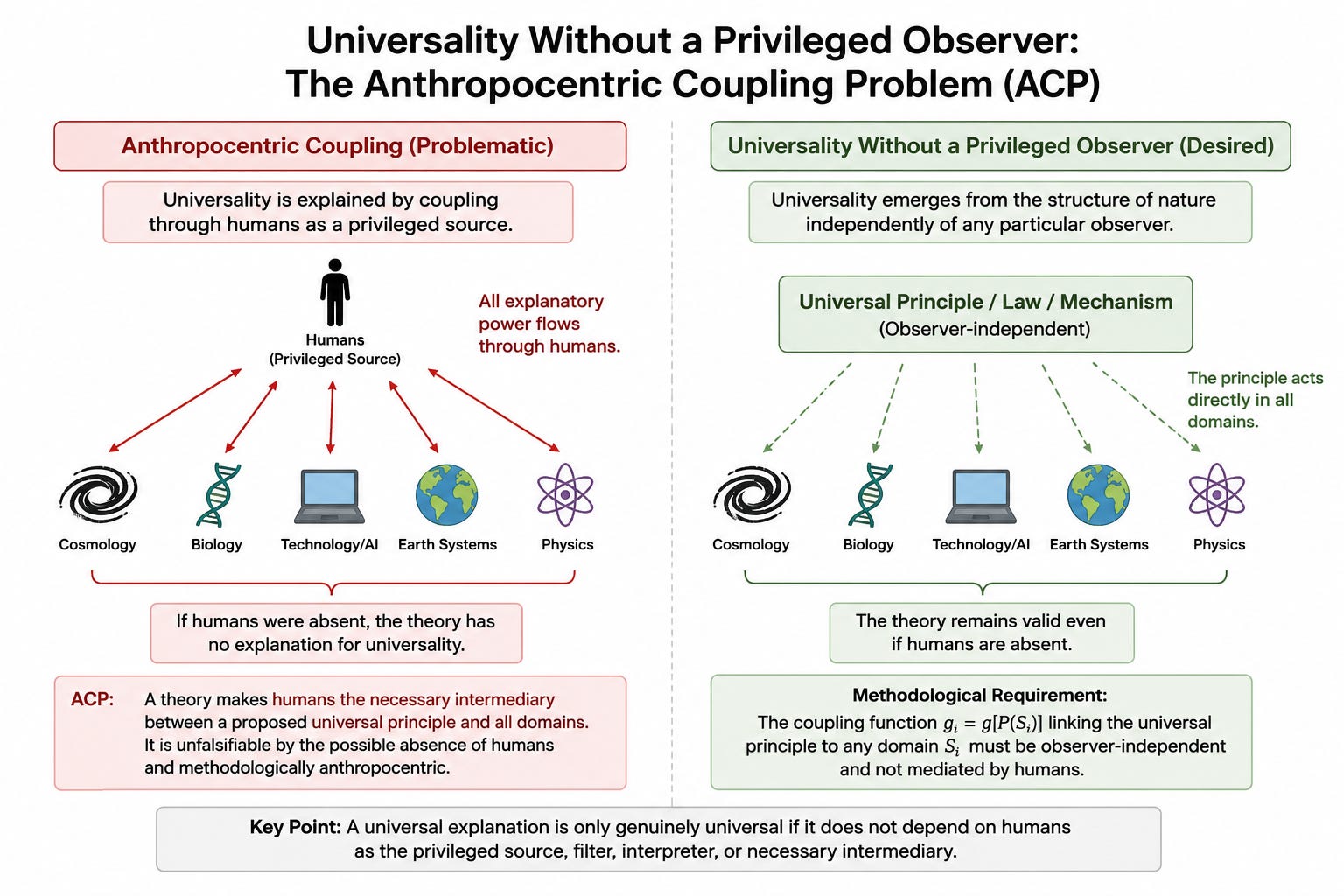
Across a wide range of proposals concerning consciousness, quantum measurement, synchronicity, psi phenomena, and participatory models of reality, the same structural assumption repeatedly appears. Humans, conscious observers, intentional agents, or systems capable of experiencing meaning are assigned a special role in the fundamental organization of physical reality. Consciousness is proposed to collapse quantum states, participate in the constitution of reality, couple to a fundamental field, influence random physical systems, or reveal acausal correlations through meaningful coincidences.
The central problem with these proposals is deeper than the absence of a complete theory of consciousness. A mechanism claimed to be universal is associated with properties of humans or systems already classified as conscious. A fundamental theory should explain humans as particular realizations of general physical principles. Reversing this direction of explanation attempts to account for the structure of the Universe through the exceptional status of one biological species.
In von Neumann–Wigner-type interpretations, consciousness occupies a special position in quantum measurement. The chain of interactions connecting a quantum system, measuring apparatus, and observer is terminated by conscious experience, which is assigned a role in state reduction. This immediately raises the problem of the physical boundary of the proposed mechanism. Why should a measuring apparatus, autonomous detector, bacterium, animal, artificial system, or another information-processing structure fail to play the same role? Without an operational criterion identifying systems capable of inducing collapse, consciousness functions as an unspecified element inserted into the dynamics.
A related difficulty appears in Wheeler’s participatory universe. Observers participate in the emergence of observable reality, and acts of measurement acquire significance extending beyond local physical interactions. If observers constitute a fundamental category of the theory, the theory must specify which physical systems qualify as observers. It must also address the status of the Universe before the emergence of life and cognitive systems. A cosmological theory cannot leave the physical status of earlier states dependent on a category that emerged only after billions of years of cosmic and biological evolution.
The Orch-OR model proposed by Penrose and Hameroff attempts to connect consciousness with objective quantum state reduction occurring in biological neuronal structures. This proposal is physically more specific because it identifies a candidate mechanism and a biological substrate. The domain problem nevertheless remains. If particular organizations of matter possess privileged access to fundamental reduction dynamics, the physical property controlling the strength of this coupling must be identified. Without such a criterion, the selection of neuronal microstructures remains a hypothesis of privileged substrate rather than a consequence derived from general physical principles.
Panpsychism and cosmopsychism attempt to avoid anthropocentrism by treating consciousness, proto-consciousness, or experience as a fundamental property of reality or of the Universe as a whole. The difficulty then reappears at another level. If the fundamental property is universal, a theory must explain the emergence of individual subjects, boundaries of experience, and differences in the organization or integration of consciousness. A general law is required to determine why some configurations correspond to unified subjects while others do not, and how individual centers of experience arise from a supposedly universal conscious substrate.
Universal consciousness field theories postulate a fundamental field whose localized manifestations correspond to individual minds. The use of field-theoretic language creates a superficial continuity with physical theory, but introducing a field does not by itself provide a physical model. The theory must define the field’s degrees of freedom, state space, dynamics, observables, interaction terms, and coupling law to arbitrary physical systems. Most importantly, it must explain why human brains, meditation, intention, or collective social events should reveal the field more strongly than non-human biological systems, artificial systems, self-organizing matter, geological processes, or astrophysical structures.
The same difficulty appears in psi research, random number generator experiments, and hypotheses of collective consciousness. Statistical anomalies are associated with human intention, attention, altered states of consciousness, or socially significant events. Such experimental strategies risk assigning humans a privileged role before the domain of the phenomenon has been established. If objective correlations exist beyond standard statistical and dynamical models, their presence should first be investigated across broad classes of physical systems. Restricting the search to human-centered situations creates a serious selection problem: a fundamental property of nature may become indistinguishable from a property of the experimental protocol, event selection procedure, or statistical analysis.
The problem becomes especially clear in theories of synchronicity. A meaningful coincidence is defined through a relation between a physical event and the psychological experience of an observer. If synchronicity is intended to describe an objective, acausal correlational structure of reality, its existence cannot depend on the presence of Homo sapiens. Analogous structures should occur before the emergence of humans, in biological systems without human observers, and in geological, astrophysical, and cosmological processes. If they do not, the theory must identify the physical property that emerged at a particular stage of evolution and activated a previously absent class of correlations.
A common methodological defect now becomes visible. Universality is inferred from the exceptional status of systems that appeared extremely late in cosmic history. Humans become sources of collapse, participants in the constitution of reality, localized manifestations of consciousness fields, generators of statistical anomalies, or interpreters of meaningful correlations. Yet no general law is provided that determines which physical systems participate in the proposed mechanism.
The Universe existed for billions of years before life emerged. Life existed long before nervous systems, complex nervous systems preceded humans, and Homo sapiens occupies an extremely small interval of cosmic history. Any theory assigning a fundamental physical role to consciousness, observation, intention, or meaning must therefore determine whether its proposed mechanism operated before the emergence of humans.
If the mechanism operated before humans existed, humans cannot be its source. They are particular physical systems in which the mechanism may be manifested, amplified, detected, or interpreted. The theory must then identify the general physical property responsible for participation in the mechanism.
If the mechanism appeared only after a particular organization of matter emerged, the theory must identify the physical criterion governing that transition. The relevant quantity may involve complexity, information integration, causal structure, self-modeling, memory, computational organization, or another measurable property. Calling this property “consciousness” does not solve the problem unless consciousness is independently operationalized and connected to physical dynamics through a quantitative law.
The problem can be expressed formally. Let Sᵢ denote an arbitrary physical system and ℳ a proposed fundamental mechanism associated with consciousness, observation, intention, or meaning. The interaction may be represented as
Sᵢ ↔[gᵢ] ℳ,
where
gᵢ = g[P(Sᵢ)].
Here P(Sᵢ) denotes a measurable physical property of the system and gᵢ determines the strength of its coupling to ℳ.
A complete physical theory must specify the function g, the property P, and the conditions under which gᵢ = 0, gᵢ ≠ 0, or varies continuously between systems. The criterion must be applicable, without prior assumptions about consciousness, to humans, animals, microorganisms, plants, artificial neural networks, self-organizing systems, measuring devices, and arbitrary physical structures.
This requirement leads to a general methodological problem.
Anthropocentric Coupling Problem (ACP). A theory exhibits the Anthropocentric Coupling Problem when it assigns consciousness, observation, intention, meaning, or another cognition-related property a fundamental causal, acausal, constitutive, or selectional role in physical reality, while failing to provide a substrate-independent, operationally defined, and quantitatively testable criterion specifying which physical systems participate in the proposed mechanism, with what coupling strength, and under what physical conditions.
The ACP is not merely a problem of incomplete definition. It directly concerns empirical content and falsifiability.
A theory that predicts an effect only for systems classified in advance as conscious can reinterpret every outcome without risking empirical failure. A positive result may be attributed to consciousness. A null result may be explained by insufficient consciousness, insufficient intention, insufficient meaning, inadequate coherence, inappropriate psychological conditions, or unknown properties of the observer. Unless these quantities are independently defined before the experiment, the theory can continuously adjust the domain of systems expected to exhibit the effect.
Such a theory does not specify a stable space of possible falsifiers.
The problem can be formulated as a methodological criterion:
ACP Criterion. Any theory assigning consciousness, observation, intention, meaning, or another cognition-related property a fundamental role in physical dynamics must define, independently of the phenomena invoked as evidence for the theory, a substrate-independent and operationally measurable coupling criterion applicable to arbitrary physical systems. The theory must specify quantitative conditions determining the presence, absence, or strength of the proposed coupling and must derive empirical outcomes whose non-occurrence would exclude the proposed mechanism or a clearly defined region of its parameter space.
Failure to satisfy this criterion has three consequences.
First, the theory does not define its domain of applicability. There is no independent procedure for determining which systems should exhibit the proposed effect.
Second, the theory risks circular confirmation. A system is classified as conscious, the coupling is therefore assumed to be present, an observed anomaly is attributed to consciousness, and the anomaly is subsequently presented as evidence for the special physical role of consciousness.
Third, the theory becomes resistant to falsification through domain reassignment. Systems producing positive results can be classified as sufficiently conscious or sufficiently coupled, while systems producing null results can be excluded from the effective domain of the theory after the fact.
A scientifically meaningful theory must prevent this flexibility. The classification of participating systems, the coupling variable, the relevant parameter ranges, the predicted effect size, and the conditions generating null results must be specified independently of the observations used to test the theory.
This requirement implies a stronger experimental strategy. Claims about consciousness-dependent physics should not be tested only by comparing conscious humans under different psychological conditions. Experiments must vary the class of physical systems themselves.
The relevant hierarchy should include nonliving physical systems, self-organizing systems, microorganisms, plants, animals with different nervous-system architectures, artificial computational systems, and humans. The theory must predict how the proposed effect changes across this hierarchy before the measurements are performed.
The crucial experimental question is therefore not simply whether an anomaly exists.
The question is whether a quantitatively specified coupling law predicts the distribution of anomalies across different classes of physical systems better than models based on ordinary dynamics, uncontrolled variables, selection effects, and statistical fluctuations.
A fundamental theory should begin with general physical structure, define a universal coupling criterion, and derive the classes of systems that participate in the mechanism. Biological organization, cognition, and human consciousness should emerge later in the explanatory hierarchy as particular physical realizations satisfying specified conditions.
The appropriate direction of explanation is
fundamental physical structure → universal coupling law → classes of participating systems → biological organization → cognition → human consciousness.
Reversing this order produces an anthropocentric explanatory structure in which properties identified through human experience are projected onto the fundamental ontology of the Universe.
Universality cannot be derived from human exceptionalism.
A fundamental theory must explain the distinctive properties of humans as consequences of principles applicable to arbitrary physical systems. A theory that explains the structure of the Universe by assigning humans, conscious observers, or human-defined meaning a privileged fundamental status reverses the proper direction of physical explanation.
The central question for any theory proposing consciousness-dependent physics is therefore:
What independently measurable physical property distinguishes systems that couple to the proposed fundamental mechanism from systems that do not, what quantitative law determines the strength of that coupling, and what possible observation would falsify the proposed law?
Until these questions are answered, the theory remains incomplete as a physical theory, regardless of whether its central concept is consciousness, observation, intention, meaning, synchronicity, psi, or a universal field.